
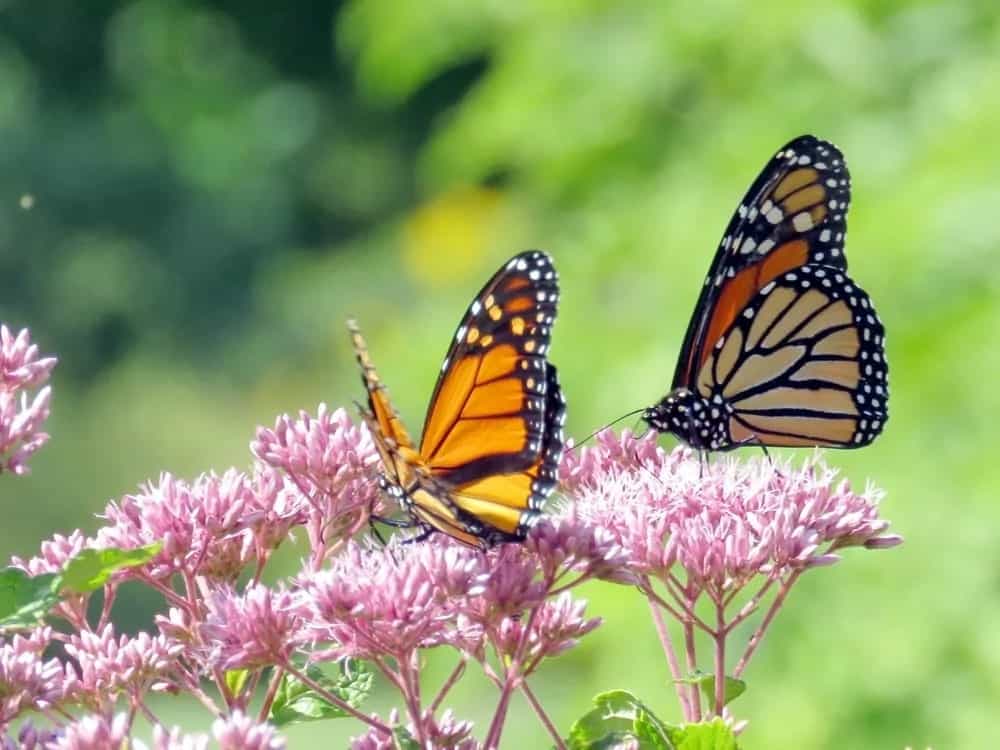
Butterflies are some of the most familiar and popular forms of insects mainly because of how commonly one can find them flying around in their garden while sporting a plethora of beautiful colors and patterns.
There are more than 17,500 species of butterflies in the whole world, and 750 of them are found in the United States only. They are also the only group of insects whose wings are covered with scales, and one of their most distinctive feature is their ability to coil or curl up their proboscis.
The word ‘butterfly’ is believed to have been derived from “butterfleoge” in old English which actually means ‘butterfly’ in modern English terminology. A very fascinating theory behind this unique name is that once during ancient times, witches that resembled butterflies in terms of shape used to steal milk and butter, hence, they got the name “butterfly”.
Evolution of Butterflies

A few scientists believe that butterflies primarily emerged from the Cretaceous period, which is often referred to as “The Age of Flowering Plants”. This period occurred 65 million to 135 million years ago, apparently the time when dinosaurs used to roam around the earth.
This belief stemmed from the basis of how in today’s times, there is such a dedicated and particular association between butterflies and flowering plants.
Note: This post may contain affiliate links which will take you to online retailers that sell products and services. If you click on one and buy something, I may earn from qualifying purchases. See my Affiliate Disclosure for more details.
Another distinct theory suggests that butterflies are relatives or family members of an obscure moth family that is called the Hedylidae. So, because these moths are the closest living relatives of butterflies, according to which butterflies are nothing but a group of brightly colored moths.
Types of Butterflies
There is a large number of butterfly species and varieties that are found on this earth, across most parts of the world.
However, below are some of the most common and popular types of butterflies that you might even find flying around in your garden.
1. Swallowtail Butterfly

These butterflies have over 500 species, and they belong to the family Papilionidae. They are really large, colorful, and very widespread with the majority of their species found in every continent except Antarctica.
Swallowtail butterflies are named so because of their distinctive tail-like extensions emerging from the hind wings. However, some of its species are also tailless. Their wingspan of these butterflies both male to female typically lyes 8-90 mm.
These are distributed across the temperate and tropical regions, and the greatest diversity is found in sub-tropical regions particularly in East Asia and Southeast Asia. 40 of its species are found in North America while 12 are found in Europe.
These butterflies come in a variety of different colors and patterns, ranging from red, yellow, orange, and green, often accompanied by green, black or blue backgrounds. They solely feed on milk parsley while some may also prefer wild carrot.
The species normally breeds marshes, and open fens and some occasional migrants are frequently seen on grasslands located near England’s south coast.
2. Brush-footed Butterfly

These belong to the Nymphalidae family and are also sometimes referred to as ‘four-footed butterflies’. This other common name basically comes from the fact that these butterflies have only four walking functional legs.
The wingspan of most species ranges from 35-90 mm, which is about 1.5-3.5 inches. This family is believed to be the largest family of butterflies, considering how it has over 6000 species that are distributed in most parts of the world.
Their wings are usually brown, yellow and white with different colored markings on their undersurfaces that typically sport duller colors. These butterflies are generally medium-to-large sized, and they are known to stand on four legs while two of their other legs are almost always curled up.
One of the varieties of these brush-footed butterflies is called the ‘peacock butterfly’ that is native to parts of Europe and Asia. An interesting fact about this butterfly is that it makes a hissing sound when it senses danger and is in an alarming state.
3. American Snout Butterfly

Also called common snout butterfly, the American snout Butterfly belongs to the sub-family called Libytheinae that further belongs to the family Nymphalidae, the brush-footed butterfly. They are typically found in regions of both the South and North America and their name primarily comes from the fact that they have very long and elaborate snouts.
The wingspan of these butterflies ranges from 3.5-5 cm their palms that form the snout are generally extended forward. These are relatively small butterflies that often come in very dull colors.
The upper surface of their wings sports a brownish-black color coupled with orange patches and white spots on the forewings. The underside of the hind wings, on the other hand, is a beautiful purplish gray shade and sometimes even brown.
Fascinatingly, the elongated ‘snout’ of these butterflies has generated a lot of interest among people where most of them question the purpose of it. This led to the belief that perhaps such a long snout helps the butterfly imitate a dry leaf and basically camouflage themselves to as a way of protection against predators.
Since their snouts are mostly shaped and colored cryptically so they are often missed by a majority of butterfly enthusiasts.
4. Red Admiral Butterfly

This is popularly known as a strong-flying and large butterfly that is commonly found in gardens and parks. These are quite different and distinctive types of butterflies that have majorly come from Ireland and Britain.
Red Admiral Butterflies belong to the Nymphalids family, and their wingspan ranges from 67-72 mm for a male to female. They are described as medium-sized and highly well-characterized butterflies and are famous for their black wings, coupled with white spots and orange bands.
These butterflies typically reside in warmer areas; however, they choose to migrate towards the north during the spring and autumn seasons. An interesting fact about these butterflies is that they are incredibly territorial which means the female red admirals will only mate with those male admirals that hold territory.
They also have very erratic and irregular flights. For instance, the male butterflies usually wait for females on any available ridge top available, where the latter lays eggs singly on plant leaves.
Their habitats typically consist of marshes, moist woods, parks, moist fields, yards, and fields. You will also find them in any habitat ranging from sub-tropics to tundra.
5. Monarch Butterfly

As the name evidently suggests, Monarch butterflies are the king of all butterflies and are also the most beautiful species of all.
They are easily recognized or identified by their stunning combination of orange, black and white markings which further also include vibrant orange wings with black veins, white dots, and black borders.
Monarch butterflies are typically found in South, North and Central America, as well as some regions of Australia, Western Europe, and India. The wingspan of most full-grown monarch butterflies reaches around 5 inches while the average is usually 4 inches.
The name ‘monarch’ apparently stemmed from paying honor to King William III of England, who was also given the title of ‘Prince of Orange’. It is assumed that the king’s title is a reference or an indication towards the butterfly’s main color which is why they are called monarchs.
The upper side of the wings of these butterflies is a tawny orange shade with black margins that are followed by a series of white spots. The color and shape of their wings changes at the start of the migration process and turns into a red shade with a more elongated shape as compared to the later migrants.
The monarch butterflies ideally go through a series of four stages as a part of their lifecycle and a series of four generations in a single year.
6. Karner Blue Butterfly

This is a small, delicate butterfly that is considered to be an endangered sub-species of the small blue butterfly. Back in the days, Karner blue butterflies were abundantly found on the northern edge of the blue lupine range that extends from Southern Maine all the way to eastern Minnesota.
In recent times, however, they a